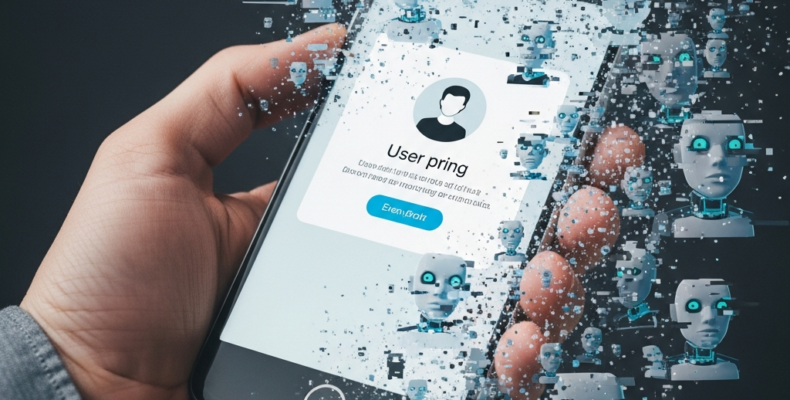
Your app has no idea who’s actually using it.
Deepfakes passed your onboarding. Fake IDs sailed through your sign-up. And you celebrated those user numbers. Here’s what’s really happening — and how to stop it.
You spent months building your app. You nailed the onboarding flow. You A/B tested the sign-up screen. You celebrated when your registered user count hit five figures.
Now answer this honestly: how many of those users are actually real people?
Not bots. Not stolen identities. Not someone holding a printed photo of a face in front of their webcam to bypass your verification. Real humans.
The uncomfortable truth is that most digital platforms today have a ghost problem. And the industry keeps dancing around it.
The fraud you’re not seeing is the fraud that’s killing you
Identity fraud isn’t a future threat. It’s happening right now, at scale, in plain sight. Fraudsters don’t need sophisticated tools anymore. A deepfake face costs less than your morning coffee. A fake ID template is a Google search away. And most “identity verification” systems? They’re checking boxes, not checking people.
Traditional verification asks: does this document look real?
The right question is: is the person presenting this document actually present, alive, and who they claim to be?
Those are two completely different questions. Almost nobody is asking the second one.
What “liveness detection” actually means — and why most people get it wrong
Somewhere along the way, “liveness detection” became a buzzword that got slapped on anything with a camera. Blink once? You’re verified. Smile at the screen? Great, you’re a human.
Except you’re not. Those checks are trivially defeatable. A looped video on a phone screen can pass a basic blink test. A high-resolution printout can fool a poorly trained model. And a well-constructed deepfake can slip through almost anything that isn’t purpose-built to catch it.
Real liveness detection is not a checkbox. It’s a layered system — one that combines micro-expression analysis, depth perception cues, neural network classification, and behavioral biometrics to establish that a live, present human being is behind the camera, right now, in real time.
How a complete identity verification stack actually works
The platforms winning the security battle aren’t relying on any single layer. They’ve built a chain — where each step confirms what the last one started.
This isn’t theoretical. This is the exact pipeline that financial institutions, fintech platforms, and enterprise onboarding systems are running today — the ones that have stopped treating identity as an afterthought.
The platforms that will win the next five years are building this now
Here’s what’s changing fast: fraud is no longer a back-office problem. It’s a growth problem. Every fake account that gets through your onboarding poisons your data, distorts your metrics, and exposes you to regulatory liability you may not even know you’re carrying.
The platforms that are pulling ahead aren’t spending more on ads to compensate for bad data. They’re locking their foundations — verifying every user at entry, building trust into the product from day one, and turning compliance from a cost center into a competitive moat.
When your platform can say “every user on our network is a verified, real human identity” — that’s not just a security claim. It’s a product feature. It’s a sales argument. It’s the kind of trust signal that closes enterprise deals and unlocks regulated markets that your unverified competitors can’t touch.
What to look for in a liveness & KYC API (and what to avoid)
Not all KYC solutions are the same. Before you integrate anything, ask these questions:
Does it detect deepfakes specifically? Basic liveness detection was built before generative AI. If the model wasn’t trained on synthetic media, it will fail on modern deepfakes — period.
Can it match a live face to a document? Liveness alone tells you there’s a real person present. It doesn’t tell you which person. Without a document match step, you’ve solved half the problem.
Is it compliant out of the box? GDPR, CCPA, KYC/AML — if the vendor can’t tell you exactly how they handle biometric data and what frameworks they’re compliant with, walk away.
How fast is it? Enterprise-grade verification should be near-instant. If your user is staring at a loading spinner for thirty seconds, you’ve already lost them.
Does it have a real API? You need something that integrates cleanly with web, mobile, and desktop — not a black box that takes a week to onboard.
The identity problem is not going to solve itself. Fraudsters get better tools every quarter. Regulations get stricter every year. The gap between platforms that have real verification and platforms that don’t is widening — and it’s widening fast.
The question isn’t whether you need this. The question is whether you’re going to build it yourself, bolt on something inadequate, or work with a system that’s already solved it.
See if your platform would pass our test.
QuantoSei’s AI-Powered Liveness Detection & KYC System is live, documented, and ready to integrate. Try the demo — no commitment, no setup time.